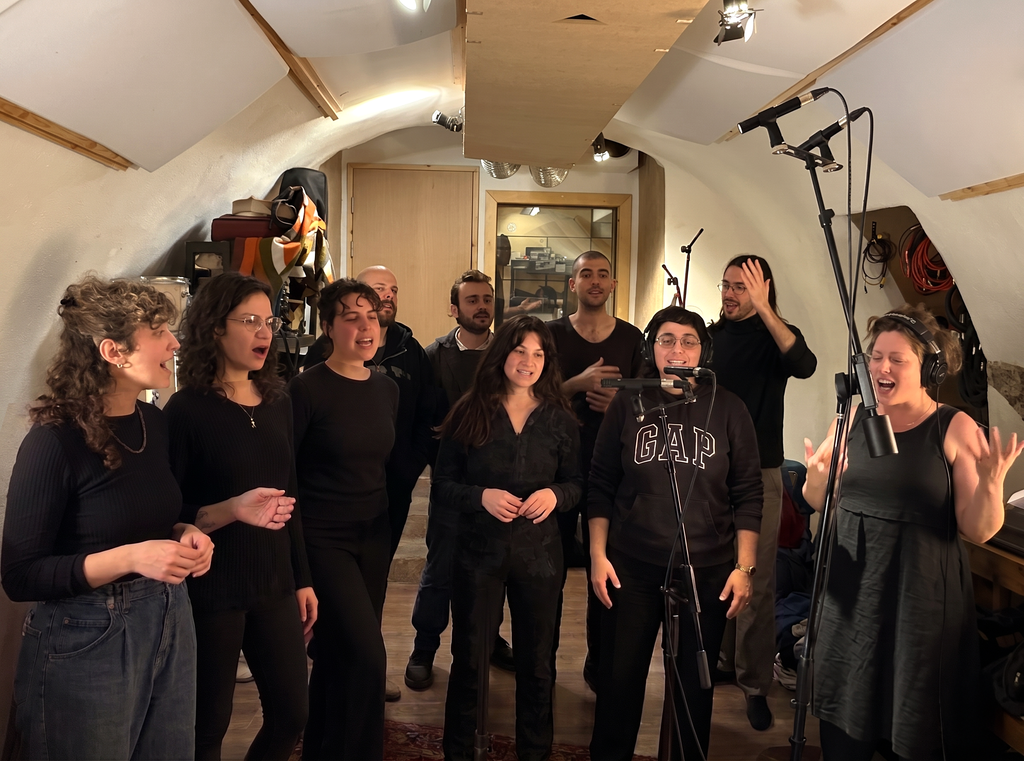
Esperoj (Esperanto for ‘Hopes’) is an interactive sound installation based on a vocal composition for a choir. The starting point of the work is the poem La Espero (‘The Hope’), written by L.L Zamenhof in Esperanto and considered the anthem of Esperanto speakers worldwide. Esperanto, a constructed language created in the late 19th century by Zamenhof to serve as a universal second language for all humanity. The song (link), whose lyrics faithfully represent the author’s utopian vision, was composed and arranged in the late 19th century in an orchestral march style, reminiscent of other national anthems around the world. Through recomposing and re-recording with a student choir and an ensemble of vocal soloists, Esperoj deconstructs the text from its conventional musical form and develops it as a polyphonic, non-hierarchical, and diverse experience. The choir provides the tonal and textural environment, creating a sense of collectivity, while an ensemble of five soloists sing different “truths,” hinting at a multiplicity of perspectives.
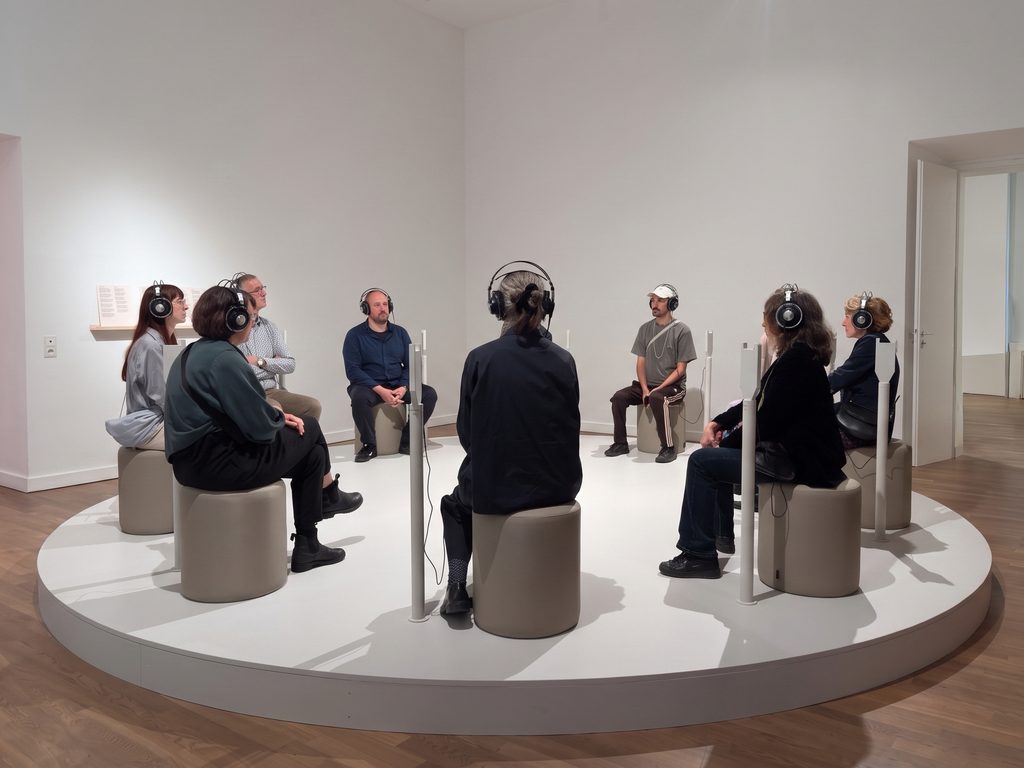
The interactive installation consists of a circle of ten seatings, placed at equal distances on a round stage. Alongside each seating is a pair of headphones on a dedicated stand that allows the system to monitor the number of listeners at any given moment. The first channel of Esperoj begins playing the moment a visitor puts on the first pair of headphones. As additional visitors join, more audio channels open, and the piece becomes more complex. When visitors remove the headphones, the audio channels gradually fade out until the last visitor returns the final pair of headphones and the work turns off. The number of listeners affects in real-time the spatial nuances of the music, which shifts and evolves from verse to verse. In every listening scenario—alone, as a pair, or as a small or large group—the work differs in the emotional tone it generates. Although there is no direct communication between audience members, the interactive dimension invites listeners to transform listening into a meaningful and active act.
To illustrate the interactive dimension, here are excerpts from the work across different listening scenarios:
The work was first presented in the exhibition The Opposite of Now, curated by Shelley Harten and Julia Friedrich at the Jewish Museum Berlin. Catalogue Essay written by Dr. Maayan Sheleff.
Additional credits list:
Laila Mazal Yenishen – Concept development partner, composition, and musical direction /// Aviad Zinemanas – Sound editing, mixing, and programming /// Lead Singers Ensemble – Or Aloni, Tom Zilberberg, Laila Mazal Yenishen, Ariel Laikin, Amit Fishbein /// Choir – Students and faculty of the New Music Department at Musrara Naggar School of Art and Society: Or Aloni, Dror Bahat, Dorin Gal, Tal Gershonovitz, Noa Weinstein, Dor Zlekha Levy, Shaked Haninovich, Lilach Moskovich, Naama Tamaria Mokady, Laila Mazal Yenishen, Yair Sheyovitz /// Recording Producer – Or Aloni /// Recording Engineer – Ron Sheskin, Mazkeka Studio, Jerusalem /// Technical Development and Setup – Johannes Scherzer